Which Music Streaming Services Filter AI Music? We Scored All 8 (October 2026)
Tidal is the only one of the eight big music streaming services that lets you switch AI music off. Its AI policy page says you can turn off AI-labeled recordings in Settings, after which they won't play and drop out of your recommendations. Deezer and Qobuz label fully AI tracks and keep them out of recommendations by default, but give you no switch. Spotify labels some fake "AI persona" artists and leaves the rest of the AI music alone. Apple Music, YouTube Music, Amazon Music and SoundCloud give listeners nothing to see or toggle yet.
We scored all eight on six checks that matter to a listener. Here's how they landed, what's actually happening in your feed, and what you can do about it today.
Key takeaways
- Tidal scored 11 of 12 on our AI Shield Score. Qobuz got 9, Deezer 7, Spotify 4, Apple Music and YouTube Music 1 each, Amazon Music and SoundCloud 0.
- The flood is real but mostly unheard. As of June 2026, more than half of what's uploaded to Deezer every day was fully AI, yet AI tracks get only 1 to 3% of its streams, and Deezer says up to 85% of those plays are fraudulent.
- Thumbs down doesn't fix it. On Spotify and YouTube Music, disliking a track blocks one song, not the uploader behind dozens of lookalike artists.
- Labels mostly rely on uploaders telling the truth. Only Deezer, Qobuz and Tidal use their own detection to label AI music for listeners, and even the best detectors can be fooled by simple edits like a pitch shift.
- Switching won't clean your library by itself. Deezer says 43% of people moving to it already have AI tracks in their playlists. Scan before you transfer.
On this page
- The AI Shield Score: all 8 services at a glance
- How we scored them
- How big the AI flood actually is
- Service by service
- What listeners are actually finding in their feeds
- How to keep AI music out of your feed
- Myths and stale stats you'll keep seeing
- The case against labels
- Thinking of switching? Scan before you move
- FAQ
- Methodology and what we'll revisit
The AI Shield Score: all 8 services at a glance
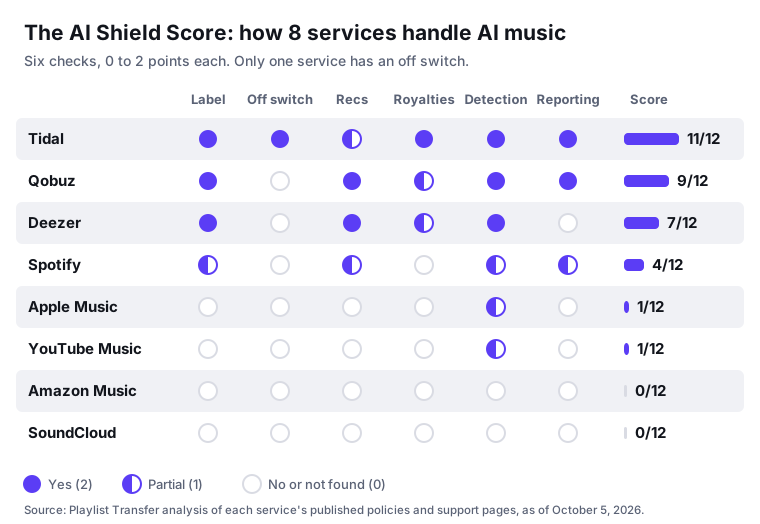
| Service | Label | Off switch | Recs | Royalties | Detection | Reporting | Score |
|---|---|---|---|---|---|---|---|
| Tidal | Yes | Yes | Partial | Yes | Yes | Yes | 11/12 |
| Qobuz | Yes | No | Yes | Partial | Yes | Yes | 9/12 |
| Deezer | Yes | No | Yes | Partial | Yes | Not found | 7/12 |
| Spotify | Partial | No | Partial | No | Partial | Partial | 4/12 |
| Apple Music | Not yet | No | No | No | Partial | Not found | 1/12 |
| YouTube Music | No | No | No | No | Partial | Not found | 1/12 |
| Amazon Music | No | No | Not found | Not found | Not found | Not found | 0/12 |
| SoundCloud | No | No | Not found | No | Not found | Not found | 0/12 |
Bandcamp isn't in the table because it isn't really playing the same game. It banned music made wholly or substantially by AI in January 2026 and removes tracks on suspicion. If your goal is zero AI, buying on Bandcamp is the strictest option going, but it's a store, not a streaming subscription.
How we scored them
We call it the AI Shield Score. It asks six questions from the listener's side of the screen, not the label's or the artist's. Each check gets 2 points for yes, 1 for partial and 0 for no or nothing we could find in the service's own published material.
- Label. Can you see a tag on AI tracks or AI artists in the app? Full marks only for a label based on the service's own detection. Self-declared credits or identity-only badges get 1.
- Off switch. Is there a setting that stops AI music playing or showing up in recommendations? This is the thing listeners ask for most.
- Recommendations. Is fully AI music kept out of algorithmic and editorial playlists by default, without you doing anything?
- Royalties. Is fully AI music blocked from earning money? Blocking only the fraudulent share gets 1.
- Detection. Does the service find AI tracks itself, or does it wait for uploaders to own up? Self-declaration plus some in-house review gets 1.
- Reporting. Is there a documented way for a listener to flag a suspected AI track? An AI-specific route gets 2; a general "deceptive content" route gets 1.
A zero sometimes means "we found no public policy," not "we know they do nothing." Amazon Music and SoundCloud may have internal measures. If they do, they haven't told listeners, and a listener can't benefit from a filter they don't know exists.
How big the AI flood actually is
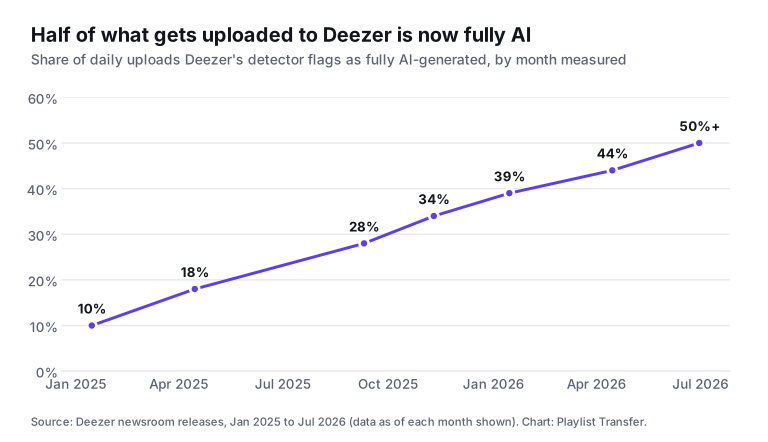
Deezer is the only service that has published a running count, and the numbers moved fast. In January 2025 its detector flagged about 10% of daily uploads as fully AI. By June 2026 it was more than half: roughly 90,000 fully AI tracks a day.
That's Deezer's intake, not the whole industry. But Apple Music's Oliver Schusser told Billboard in April that "more than a third" of what Apple receives is 100% AI, according to TechRadar's write-up of the interview. Similar order of magnitude, different company.
Here's the part most coverage skips. Almost nobody is listening to it.
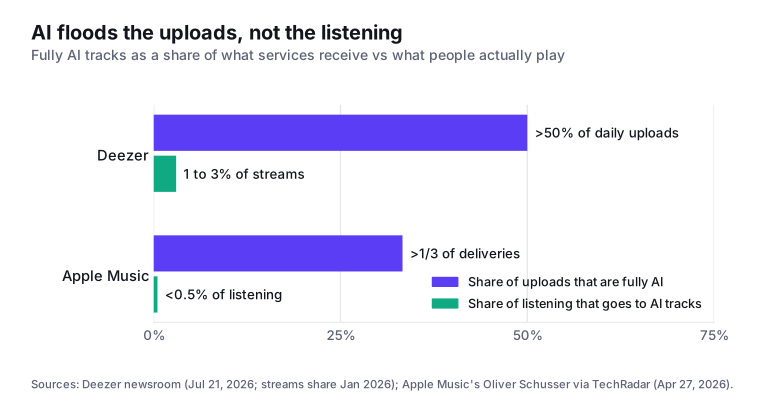
Deezer puts AI at 1 to 3% of its streams. Apple says under 0.5% of listening. Qobuz, which hasn't published an upload share, says AI accounts for 0.38% of its streams. So why upload hundreds of thousands of tracks almost nobody plays?
The real business model: fake streams
Because a lot of those plays aren't people. Deezer said in January that up to 85% of streams on fully AI tracks were fraudulent and stripped them of royalties. Qobuz put its figure at 60%.
The scheme works because of how streaming pays. Services don't pay a fixed rate per play. They pool a month's revenue and split it by share of total streams, which Music Business Worldwide walked through in detail this month. A bot play on an AI track doesn't add money to that pool. It takes a slice that would have gone to a real artist.
The textbook case is Michael Smith, a North Carolina man who pleaded guilty in March 2026 to a scheme built on AI-made songs and bot accounts. The agreed loss is about $8.09 million. His trick was spreading plays thin, around two a day per song across hundreds of thousands of tracks, so no single track looked suspicious. Sentencing is scheduled for October 6, with prosecutors asking for at least 46 months and his lawyers asking for no prison time.
For a listener, this explains something that feels contradictory. AI tracks can be a tiny share of all listening and still end up all over your Discover Weekly, because the people uploading them are playing a volume game and recommendation systems are one of the doors in.
Service by service
Tidal: 11/12, the only off switch
Tidal went furthest, fastest. It announced on June 29 that it would tag fully AI tracks and cut them off from royalties entirely, including sales through its direct upload program. Badges were reported live in the app by mid-July.
The detail most coverage missed is on Tidal's support page, updated July 20:
- You can turn off AI-labeled recordings in Settings.
- Once off, they won't play, and they're removed from your personalized recommendations as those refresh. Most update daily; album recommendations can take a few days.
- If you hear something that should have been tagged, the support form has an "I want to file an AI flag review" option. Artists who get wrongly tagged can appeal through the same form.
Why not 12? Tidal's policy doesn't say whether AI tracks are kept out of recommendations for people who leave the switch alone, so Recommendations gets a partial. Tidal also only acts on recordings it decides are wholly AI, so a track with an AI vocal over human production can still slip through.
Qobuz: 9/12, human-picked and tagged
Qobuz published an AI Charter in February promising that its editorial picks stay human-selected, deployed its own detector in March, and on September 24 started showing an AI tag in the app. AI-flagged releases are kept out of editorial and algorithmic recommendations. It also pulled about 4 million AI tracks that nobody was listening to out of search, and listeners can report untagged tracks they suspect are AI.
What it lacks is the switch. You get a cleaner default, not a control. Royalties get a partial because Qobuz withholds pay from the fraudulent share (60% of AI streams), not from AI music as a whole. Qobuz is also unusually frank about the limits, admitting that no reliable way exists yet to identify all AI content with certainty.
Deezer: 7/12, the best data, no toggle
Deezer built the detector the rest of the industry cites. It has tagged albums containing fully AI tracks since June 2025, keeps those tracks out of algorithmic and editorial playlists, and in July said it was removing AI tracks with no streams in six months along with any tied to fraud.
You'll read in a few places that Deezer has an AI toggle. It doesn't. Its own support page on AI tagging says the notice can't be turned off and that AI content is already excluded from recommendations. A community request for a block option has been open since September 2025 with no Deezer response.
What Deezer does offer is a free AI Music Detector that scans your playlists on other services and shows how much of them is AI. More on why that matters if you're switching, below. We found no documented listener route for reporting a suspected AI track, so Reporting scores 0.
Spotify: 4/12, labels the persona, not the music
Spotify has done a lot of announcing. The pieces:
- AI credits (April 2026 beta). Artists and distributors can declare AI use, which then shows in Song Credits on mobile. It's voluntary, and the absence of a credit proves nothing.
- "Verified by Spotify" (April 30). A green check for human artists. Profiles that appear to mainly represent AI personas aren't eligible.
- "AI Persona" badges (announced August 11). These mark artists whose public identity is an AI-generated photorealistic person, either self-declared ("AI persona") or applied after Spotify's review ("Likely AI Persona"). Per Spotify's support page, music from these artists isn't included in editorial or personalized recommendations unless you engage with them, for example by following.
- Spam filter and impersonation ban (September 2025). Spotify said it had removed over 75 million "spammy" tracks in the prior year and banned unauthorized voice impersonation.
The catch is in Spotify's own announcement: the AI Persona badge is "about the artist's public identity, not about how the music was made." A human-fronted project releasing fully machine-made songs doesn't trigger it, and neither does a cartoon AI band. Spotify said badges would begin appearing in mid-September and its support page still describes them as rolling out gradually, so don't be surprised if you haven't seen one.
There's still no listener switch. The community idea to mark or disable AI songs had 14,493 kudos and 213 pages of comments when we checked on October 5.
Apple Music: 1/12, a label that hasn't landed yet
Apple introduced Transparency Tags in March, a voluntary way for labels and distributors to declare AI use in the track, composition, artwork or video. In August it told partners the tags would become mandatory where AI made a "material portion" of a release, and that a listener-facing "Made With AI" label was coming "later this year". We couldn't confirm that label is live, so it scores 0 for now.
There's no filter and no announced change to recommendations. Detection gets a partial: tags are self-declared, though Schusser says Apple also has in-house technology to spot AI models. Apple's score should rise once the label ships, and we'll update this page when it does. Meanwhile, an Apple Community question on excluding AI songs from Apple Music collected 175 "me too" clicks before it was closed with "send feedback."
YouTube Music: 1/12, labels for videos, not songs
YouTube started automatically labeling photorealistic AI video in May, but those labels sit on videos, and MBW reports that a label alone doesn't change how a video is recommended. We found no AI label for music tracks in YouTube Music and no recommendation policy for them. MediaNama noted that YouTube hasn't published how it identifies or de-prioritizes AI music.
Subscribers have noticed. A widely shared r/YoutubeMusic post in January said 6 of 10 recommendations were AI, and Android Authority found that a thumbs down only blocks the one song while lookalike artists keep coming. CEO Neal Mohan has called managing "AI slop" a 2026 priority. Listeners are still waiting to see what that means for audio.
Amazon Music: 0/12
We couldn't find a public AI music policy for Amazon Music, and Digital Music News came up empty too in March. Amazon is a member of the industry's Music Fights Fraud Alliance, so it's clearly paying attention to fraud. It just hasn't given listeners a label, a filter or a stated rule.
SoundCloud: 0/12
SoundCloud bans impersonation and voice-clone misuse, and asks creators to disclose AI content in the track description. That's a request, not a label, and there's no filter. It does let AI music earn money when it's made with a list of approved AI tool partners, which tells you where it stands.
What listeners are actually finding in their feeds
Platform numbers say AI is a sliver of listening. Plenty of listeners would disagree, because they don't meet it in search. They meet it in the playlists a service builds for them.
We pulled every public Spotify Community post we could find where someone actually counted the AI or spam tracks in a single weekly playlist. There are nine, from September 2023 to November 2025, and they range from 17% to 77%.
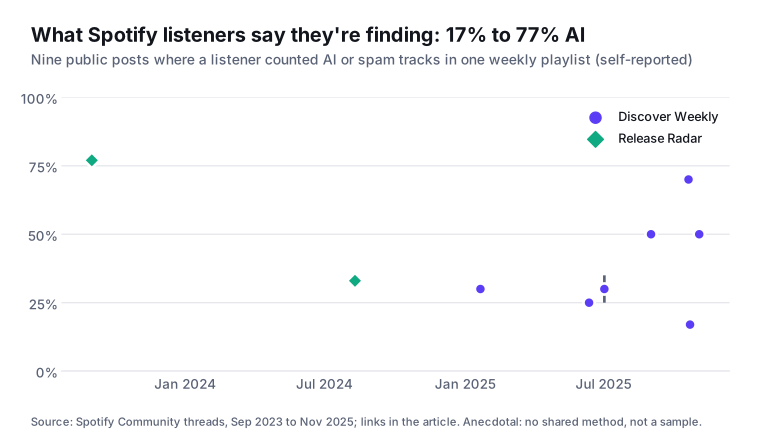
The pattern in these threads is consistent even if the numbers aren't:
- It's the algorithmic playlists. A user in 2023 counted 23 of 30 Release Radar tracks as AI or spam: two-minute songs, "Original Mix" in the title, generated cover art. Another long thread on weekly playlists filling with AI started in 2024 under the title "Half of the weekly playlists are filled with AI generated" and by October 2025 had a user reporting 70%, with every fake "artist" sitting at a similar 300,000 to 500,000 monthly listeners.
- Removed artists come back under new names. One verified AI act kept turning up in Discover Weekly, disappeared, reappeared, then spawned a lookalike.
- Real artists' pages get hijacked. In September, a 404 Media reporter uploaded an AI song to a real band's verified Spotify profile and said it was trivial to do. The same track showed up on Apple Music, Tidal and Amazon. Spotify Community has threads from people finding fake "new releases" on a deceased artist's page. Spotify's answer for artists is Artist Profile Protection, which lets them approve releases before they appear.
- Some of it charts. Sienna Rose, an act Deezer says is AI, reached over 3 million monthly listeners and the US Viral 50 in January, and Deezer's detector flagged the music as AI. That's the uncomfortable truth behind "nobody listens to it": some people do, without knowing.
Not every complaint is about AI, either. Some "fake releases" are stolen human recordings re-uploaded under new names, and some of what gets called AI is the cheap anonymous filler that Liz Pelly reported on, which predates the AI boom. The fix a listener wants is the same, though: control over what lands in their feed.
Spotify denies it pushes AI music on purpose, saying it doesn't promote or penalize tracks made with AI tools. Neutral treatment of a flood still means a lot of flood.
How to keep AI music out of your feed
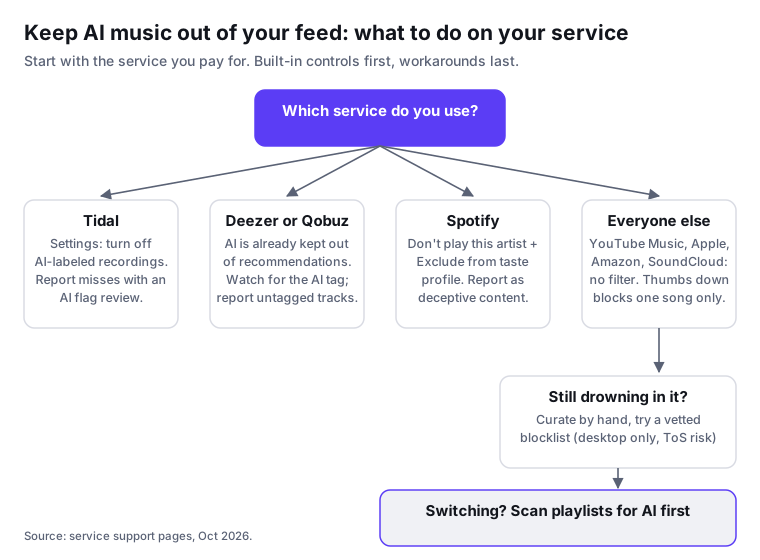
Tidal. Go to Settings and turn off AI-labeled recordings. Give your recommendations a day or two to refresh. If something slips through, use the support form and pick "I want to file an AI flag review."
Deezer. AI-tagged music is already kept out of Flow and its playlists. Look for the AI-generated content notice on album pages before you save anything, and run your playlists through the AI Music Detector if you've imported them from elsewhere.
Qobuz. Same idea: watch for the AI tag on releases and report untagged tracks you suspect.
Spotify. There's no switch, so you're working one artist at a time:
- On an artist you don't want, tap the three dots and choose Don't play this artist. On a song, choose Exclude from your taste profile so it stops shaping your recommendations. Spotify's support account pointed users to both in January.
- Don't follow suspected AI artists to "check them out later." Following is exactly the engagement that lets AI Persona music back into your recommendations.
- To report, use Spotify's Safety and Privacy Center and choose deceptive content, as TechRadar's guide explains. For a fake track on a real artist's page, use the "Wrong artist" report.
- Turn off Autoplay and Smart Shuffle if those are where you keep hitting it.
YouTube Music, Apple Music, Amazon Music and SoundCloud. No built-in tools. Thumbs down and "not interested" help a little at the song level. The honest answer is to rely less on autoplay and algorithmic mixes and more on playlists you or people you trust built.
How to spot an AI artist
These are the signs listeners mention again and again. None is proof on its own; three or four together usually is.
- A release pace no human could keep. Sienna Rose put out more than 45 songs between September 28 and December 5 last year.
- No bio, no social accounts, no live dates, and a catalog that starts in 2024 or later.
- Generated-looking cover art and press photos.
- Clusters of similar-sounding "artists" with suspiciously similar monthly listener counts.
- Short tracks, often around two minutes, with "Original Mix" tacked on.
- On Spotify, check Song Credits for an AI credit and the artist's About page for a badge. A missing badge means nothing; a present one means a lot.
Browser extensions and blocklists: what they do and the risks
When services won't build a filter, people build their own. The best known is Spotify AI Blocker, a userscript that uses Spotify's own "don't play" feature to block artists on a shared list. When we counted on October 5, that list held 7,832 artists. On YouTube Music, the YTM AI Artist & Song Blocker extension had about 1,000 users.
They can help. Know what you're signing up for:
- Terms of service. The Spotify AI Blocker README itself warns it may violate Spotify's terms. It works by acting on your logged-in account.
- Desktop only, mostly. These run in a desktop browser. Blocks made through Spotify's own feature carry over to your phone; skip-based tools don't.
- The lists disagree. The largest list we counted is 5.7 times the size of the Soul Over AI dataset (1,375 artists), and 959 of Soul Over AI's entries had no disclosure from the artist at all, meaning they were listed on telltale signs alone. That project is now winding down partly because, as its maintainer put it, drawing clear lines is no longer possible.
- False positives happen. Choose tools that let you unblock or appeal, and check your blocked list now and then.
Myths and stale stats you'll keep seeing
- "Spotify deleted 75 million AI songs." Spotify said 75 million "spammy" tracks, a category that covers mass uploads and duplicates as well as AI.
- "Deezer lets you toggle AI music off." It doesn't. Its support page says so. Tidal is the one with the switch.
- "18% (or 28%, or 34%) of new music is AI." Those are old Deezer figures. The latest is over 50% of Deezer's daily uploads, as of June 2026. It's also Deezer's intake, not all streaming.
- "Apple Music labels AI music." Not for listeners yet. The "Made With AI" label was announced for later this year.
- "The AI Persona badge means the music is AI." It means the artist's public face is AI. The music question is separate, and a human-fronted act can use fully AI music without a badge.
- "Spotify doesn't down-rank AI at all." Out of date since mid-September for AI Persona artists, which are left out of recommendations unless you engage with them. Still true for everything else.
The case against labels
Labels and filters sound like an obvious fix. People who study this are less sure, and their objections are worth hearing before you treat a tag as gospel.
Most labels depend on honesty. Spotify's credits and Apple's tags are self-declared, and the record industry's proposed two-tag system ("AI-generated" and "AI-assisted") runs on the same metadata. Cornell psychologist Gordon Pennycook warned that with voluntary disclosure, honest disclosers could be penalized while dishonest ones avoid punishment. Fraudsters, the biggest uploaders of AI music, have zero reason to tick the box.
Detectors can be fooled. Deezer claims 99.8% accuracy, but its own researchers' 2025 paper flagged audio manipulation and new generators as open problems. A July 2026 paper co-written by Deezer researchers found existing detectors' performance collapses under simple audio manipulations like changing the speed or pitch.
Wrong labels hurt real musicians. This week the Jamaica Gleaner reported that distributor TuneCore rejected a track by dancehall artist Papa Michigan as AI, which he says was a fully human studio recording. And a Stanford and Reed study of 399 listeners found an AI label made people engage less with music whether or not the label was true.
Some people like it. MIDiA Research's Mark Mulligan argues "music AI is not going away" and the industry has to learn to live with it. The major labels have started licensing AI music companies rather than only suing them, starting with Universal's settlement with Udio in October 2025.
Our take: these are reasons to want better labels, not fewer. Most listeners still want the choice. In the Deezer and Ipsos survey of 9,000 people, 80% wanted AI music clearly labeled and 45% wanted a filter, and in the Nordic Digital Music Survey 2026 of 4,033 people, 74% wanted a filter. (Deezer sells detection tools, so weigh its survey with that in mind.) A switch you control is a better design than a hidden rule you can't see, which is why Tidal's approach scores highest here.
Thinking of switching? Scan before you move
If AI music is the reason you're leaving, the order matters. When Deezer launched its playlist detector in June, it said 43% of people switching to Deezer already had AI tracks in their playlists. Transfer tools are built to match songs from one catalog to another, not to judge them, so they copy whatever is in the playlist. Move a playlist full of AI tracks and you'll bring the problem with you, and on Spotify, playing or saving those tracks keeps feeding your taste profile.
A sensible order:
- Scan first. Run your playlists through Deezer's AI Music Detector, which works with playlists on other services too.
- Prune. Delete the AI tracks you didn't choose on purpose. Keep the ones you actually like; it's your library.
- Then transfer. Moving to Tidal? Follow our Spotify to Tidal guide, then flip the AI switch in Settings straight away. For Qobuz or Deezer, see Spotify to Qobuz and Spotify to Deezer.
- Compare the rest before you commit. Price, sound quality and catalog still matter. Our Tidal vs Spotify and Deezer vs Spotify comparisons cover those, and ethical Spotify alternatives covers how each service pays artists.
Whatever you pick, export your Spotify playlists before you cancel so you have a backup.
The pressure on services isn't letting up. Chicago musicians have called for a listener blackout of Spotify and Apple Music on October 26 and 27, and the EU AI Act's transparency rules for AI-generated content started applying in August.
FAQ
Can I turn off AI music on Spotify?
No. Spotify has no setting for it. You can block artists one at a time with "Don't play this artist," keep songs out of your recommendations with "Exclude from your taste profile," and avoid following AI Persona artists, whose music is otherwise kept out of your recommendations.
Which music streaming service has the least AI music?
For control, Tidal: it's the only major service with a setting that turns AI-labeled recordings off. Deezer and Qobuz keep tagged AI out of recommendations by default. If you want none at all, Bandcamp bans music made wholly or substantially with AI, but it's a store rather than a streaming service.
Does the Spotify AI Persona badge mean a song is AI-generated?
Not exactly. It marks artists whose public identity is an AI-generated photorealistic person. Spotify says the badge is about identity, not how the music was made.
Does thumbs down or "not interested" stop AI songs?
Only for that one song. On Spotify and YouTube Music, listeners report that similar tracks from lookalike artists keep coming. On Spotify, blocking the artist works better than disliking the song.
How do I report an AI artist?
On Tidal, use the support form's AI flag review option. On Qobuz, report untagged suspected AI content. On Spotify, report through the Safety and Privacy Center as deceptive content, or use "Wrong artist" for a fake track on a real artist's page.
Is Spotify pushing AI music to avoid paying royalties?
Spotify denies it and says it doesn't promote or penalize music for being made with AI tools. There's no public evidence either way. What is documented is that fraudsters upload AI tracks to siphon royalties, which takes money from real artists.
Will my playlists bring AI songs with them if I switch?
Yes. Transfer tools copy what's in the playlist. Scan with Deezer's AI Music Detector and prune before you move.
Can you tell AI music by ear?
Usually not. In Deezer's survey, 97% of people failed its blind test. Look at release pace, artist history and credits instead.
Methodology and what we'll revisit
We scored each service from its own newsroom announcements, support pages and policy documents, checked against trade press, as of October 5, 2026. Where a feature was announced but we couldn't confirm it was visible to listeners (Apple's "Made With AI" label), we scored it as not yet live. Where a service published nothing, we scored 0 and said so. The community chart counts only posts where a listener gave a specific number for a single weekly playlist; it is anecdotal, not a sample.
Last updated: October 5, 2026.
We'll update this page when any of these change:
- Spotify's AI Persona badges finish rolling out, or Spotify adds a listener filter.
- Apple Music's "Made With AI" label goes live.
- YouTube Music or Amazon Music publish an AI music policy.
- The Michael Smith sentencing, scheduled for October 6.
- New Deezer upload figures.
Found a service doing more (or less) than we've given it credit for? Tell us and we'll check it.